When the seeker reaches the Intermediate Level, the God-experience which has already begun becomes a solid spiritual formation for him or for her. Theology should not be subjects that pile up God-information; but rather a formation experience that is life-transforming. In this level the student is able to expose himself or herself to a comprehensive introduction to Spiritual Theology, Pauline Epistles, Sin and Grace, Prophetic Literature, an Introduction to the Holy Eucharist and a Catholic Perspective of Modern Psychology.
There is a longing in the heart of every human person to be connected - to nature, to oneself, to others and most of all to the source of one's being - the divinity. Saint Augustine aptly said, "Our hearts are restless until they rest in you". Spirituality shows us the way how different persons and movements make this connection with the divine. The word 'spirituality' is not a biblical term. The nearest we have in the Bible would be 'life in the spirit' (Rom. 8:14; Gal. 5:14). What we are referring to by the term spirituality is the life style shining through a person as a result of him/her being connected to the Divine. This module does not intend to deal with any one of the well-known spiritualities in particular, but to introduce some of them to students so that they may choose any spirituality for their further study depending on their interest and liking. Following are some of the subjects covered within the module: Spirituality of the OT, Spirituality of the NT, Spirituality of the Early Church, Didache and St. Ignatius of Antioch. Fuga Mundi spirituality, Monasticism, Spiritualities of the Franciscans and the Dominicans, Counter-Reformation Spiritualities: Ignatius of Loyola, Theresa of Avila and Mysticism.
This module covers following topics: Prophecy in ancient Israel, ancient Prophets, the call of Prophets Isaiah, Jeremiah, Ezekiel and Elisha), main teachings of the Prophets (monotheism, covenant etc.), Prophets and worship, Messianism, eschatology in the Prophets, apocalyptic thought in Prophets and the social teachings of the Prophets. At the same time, the student will be able to understand that all Prophets are not literary, and that there are non-literary Prophets such as Elijah and Elisha. Hence, the importance of a Prophet in the Old Testament cannot be measured only by the literary contribution of a Prophet. Understanding prophetic literature and ministry is vital as the student begins to realize how many of these prophecies are eventually fulfilled in Jesus Christ, the Messiah.
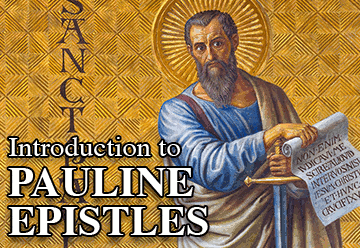
As we are well aware, a theological understanding of the Pauline Epistles is crucial in any attempt at evangelization. Although the apostles took the evangelion of Jesus Christ to the Jews and to the gentiles, it is St Paul who has left for us a plentiful of his missionary experiences. The module pays particular attention at the order of Pauline Epistles and to the missionary journeys of St. Paul. While introducing St. Paul’s Epistles to different communities the student obtains the opportunity study a number of handouts which furnish him or her with extra information. One such tool is Bible Study on Romans by the widely-acclaimed scripture scholar Dr. Brant Pitre.
Do we understand what sin really is? What actually is grace? When we pray, Hail Mary, full of grace, what do we really mean? The course on Sin and Grace is intended to motivate the students to understand the risks of the sinful nature of human beings and the importance of God’s grace. The course begins with biblical evidence with regard to the nature of sin and discusses in detail the teaching of the Council of Trent regarding the Original Sin. The second part of the course deals with the actual position of the theology of Grace in the overall context of theology and the different approaches to the subject. Grace is really a share in the Divine life which is given through God’s self-communication, which we receive through various ways, and finally in justification.
Gladys Sweeney, dean of the Institute for the Psychological Sciences, which aims to provide a bridge between science and faith, wrote on 13th January 2005 that A psychology rooted in the Catholic understanding of the human person is not only true to science, but true to God. Very true. This is the objective of this module; a Catholic understanding of the human mind and behaviour. Naturally, the module begins with general explanations of the nature and scope of psychology and goes on to explore the relationship between modern psychology and Catholicism. In the process it analyses the Freudian apathy towards religion, and goes on to explore the Jungian (Carl Jung 1875-1961) perspective, the concept of anxiety, dealing with anger, pastoral counseling, abuse of minors and psychological perspectives on Catholic Sacraments.
Many Catholic participants at the Roman Catholic Mass are not equipped sufficiently with a deeper historical and theological meaning of what they are experiencing during that rite. Many things are taken for granted and hardly anyone is bothered about seeking deeper meaning. For many, participating at Mass is simply a fulfillment of an obligation. The student will be amazed at what is revealed in this module as each part of the Mass is treated specifically to give its historical, theological, spiritual and pastoral significance. For instance, if someone is asked to explain the meaning of the entrance procession, giving its history and theology and the ritual organization, probably the answer will be deficient. The module will analyze not only the Gathering Rites, but also the Liturgy of the Word, the rite of preparation of the gifts and the altar, the Liturgy of the Eucharist, the rites of Peace and Holy Communion and finally the rite of commissioning or the sending off.